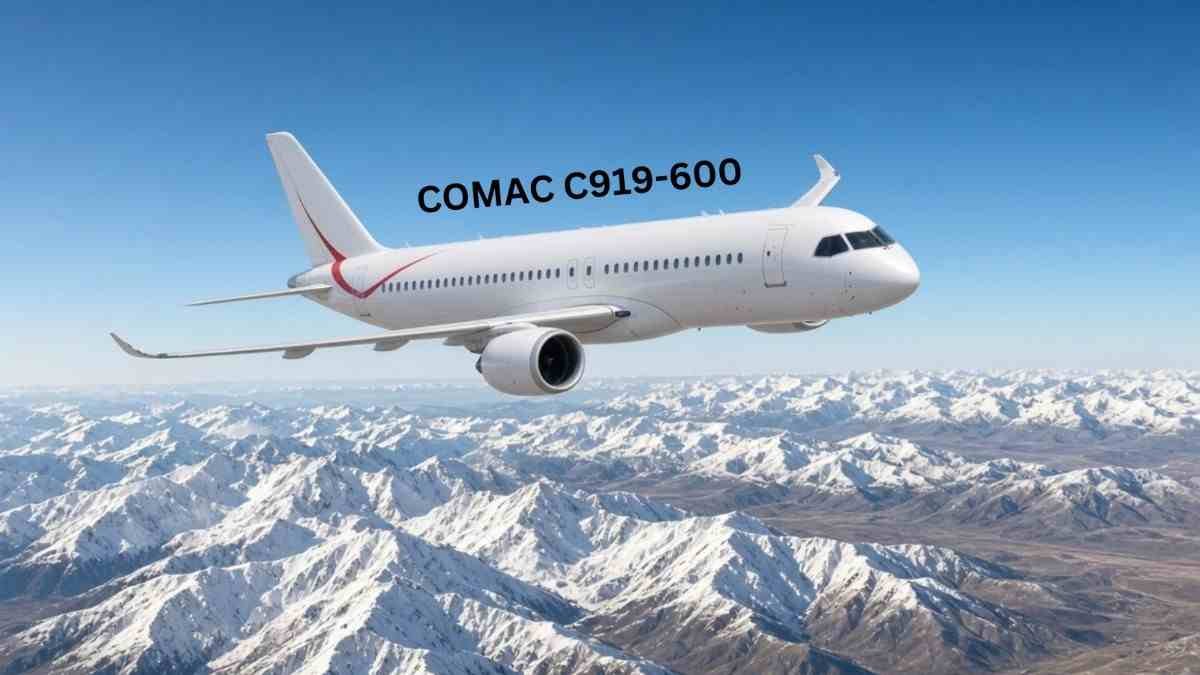
COMAC C919-600: China is building a new kind of passenger jet for its high mountain airports and the story is unfolding right now in a way that could change how airlines fly over the Tibetan Plateau. The Comac C919 600 is a shorter version of the regular C919 and it just took to the sky for the first time. This jet aims to handle thin air where other planes struggle and it forms part of a bigger family that Comac hopes will serve many Chinese routes without relying only on planes from other countries.
Why High Altitude Airports Need Special Planes
China has many airports sitting more than three thousand meters above sea level. Places like Lhasa Gonggar sit around three thousand five hundred seventy meters and Daocheng Yading reaches over four thousand four hundred meters. At those heights the air is thinner so engines make less power and wings create less lift. A normal jet must leave passengers or fuel behind just to get off the ground safely. Runways need to be longer too. For years only specially prepared Airbus A319 planes could serve some of these routes regularly. That left little choice for airlines that fly the plateau every day. Comac saw this gap and decided to create a plane that fits the need from the start.
The C919 600 Story and Its First Flight
In late twenty twenty three Comac and Tibet Airlines now called Xizang Airlines agreed to work together on a high altitude version. The airline became the first to commit to forty of these planes at an air show in early twenty twenty four. Engineers removed six frames from the middle of the fuselage.
That cut the length from about thirty eight point nine meters down to roughly thirty four meters. The plane became lighter so it can climb better when the air is thin. The first prototype registered B 002U appeared at Shanghai Pudong in early twenty twenty six. Ground tests followed including taxi runs and high speed braking. Then on July twenty nine twenty twenty six the plane lifted off from Shanghai Pudong at seven fifty nine in the morning.
It stayed in the air for one hour and fifty nine minutes climbing to about twenty two thousand feet before landing safely at nine fifty eight. Comac said every planned test item was completed. This first flight stayed near the coast in thicker air. Real high altitude checks will come later. A regular C919 already flew into Lhasa in twenty twenty four to collect data. That information helped shape the shorter design. The goal is to prove the plane works safely day after day on plateau routes
Building a Full Family of Planes
Comac is not stopping at one size. The company plans a family that shares the same cockpit so pilots can move easily between models. The C919 600 sits at the short end with room for about one hundred forty to one hundred sixty people. The baseline C919 100 carries one hundred fifty eight to one hundred ninety two.
A longer C919 800 is also in the works with China Eastern Airlines and aims for around two hundred ten seats with service hoped for near twenty thirty. This family approach mirrors how other makers built strong lineups over many years. One training program covers several sizes and airlines can match the right plane to each route. For China the focus starts at home where dozens of high altitude airports create a ready network.
Looking at Other Popular Jets Side by Side
Here is a simple table that shows key highlights of the main planes in this size range. Numbers come from public information and can change as programs move forward.
| Aircraft | Typical Seats | Focus Area | Current Status Notes |
| Comac C919 600 | 140 to 160 | High altitude Chinese routes | First flight July 2026 joint work with Xizang Airlines |
| Comac C919 100 | 158 to 192 | Standard Chinese domestic routes | In service since 2023 with growing numbers delivered |
| Boeing 737 Max | 138 to 230 depending on model | Worldwide short and medium routes | Long service history with many operators |
| Airbus A320 family | 140 to 240 depending on model | Worldwide short and medium routes | Dominant in many markets including high altitude niches until now |
| MC 21 | 132 to 211 depending on model | Russian and some international routes | Development continues with domestic engines after earlier challenges |
The C919 600 targets the same high places where the Airbus A319 has worked almost alone. The regular C919 competes more directly with the middle of the Boeing 737 Max and Airbus A320 ranges. The MC 21 from Russia faces its own path with engines made at home. Each plane brings different strengths shaped by the needs of its home market.
Read more : Earn From Instagram
Challenges That Still Stand Ahead
Building planes is hard and Comac still works through several steps. Production of the regular C919 has grown but remains lower than big makers who deliver hundreds each year. Engines on current C919 planes come from a partnership outside China. Work continues on a domestic engine called the CJ 1000A that could one day reduce that need. Certification outside China takes time.
European authorities have been reviewing the C919 for years and full approval may still be several years away. Without it the plane stays mainly inside China for now. Reliability in daily airline use and real high altitude performance must also prove themselves over time.
Western makers have tried short high altitude versions before. Some older models sold only a few examples because the market was small. Comac works with a different approach. The main customer already knows the plateau routes well and helps shape the design. Success can start by serving Chinese needs first rather than needing worldwide sales right away.
What This Means for the Wider Aviation World
If the C919 600 reaches airlines around twenty twenty eight as hoped it will give Chinese carriers a home grown choice for mountain routes. Airbus may see less demand for its special A319 versions in that niche. Boeing feels more pressure from the wider C919 program as Chinese airlines look at domestic options for many routes. Neither faces an overnight change but the signal is clear. Comac is building step by step toward covering more of what Chinese aviation needs.
The first flight over Shanghai was only the opening chapter. Later tests will check how the plane behaves in thin air. Airlines will watch how easy it is to maintain and how well it keeps schedules. Other carriers beyond the first one may join if the results look strong. History shows that specialized planes can struggle if the market stays too narrow. Yet a state supported program focused on a concentrated set of domestic airports has a different chance. Around twenty five of the world high altitude commercial airports sit inside China. That creates a natural base to start from.
Looking Forward
Comac continues taxi tests and system checks while the family of planes takes clearer shape. The regular C919 already carries millions of passengers on dozens of routes inside China. Adding the shorter high altitude model and later the stretched one gives more flexibility. Domestic engine work moves ahead slowly but steadily. International approval remains a longer journey.
Readers who follow aviation can watch for more flight test news from Shanghai and later from the plateau itself. The story of the C919 600 shows how one country is solving a real geography problem with its own design. Whether the timeline holds or shifts a little the first flight already marks real progress
FAQ
Q1. Is the Comac C919 600 safe?
Answer: Safety comes from careful design, testing, and certification by aviation authorities. The aircraft is still in the testing and development stage, so complete safety results are not yet publicly available. Chinese aviation authorities must approve it before passenger flights begin, while further high-altitude testing will provide additional safety data.
Q2. What is the range of the Comac C929?
Answer: The C929 is a larger wide-body aircraft project that is still under development. Public information about its exact range remains limited because the program is still progressing. For now, the C919 family has clearer range information and is mainly designed for shorter and medium-distance routes.
Q3. Is Comac a threat to Boeing?
Answer: COMAC mainly focuses on the large Chinese aviation market. As more C919 aircraft enter service, Chinese airlines may choose them for some domestic routes that were previously served by Boeing or Airbus aircraft. Its global impact could increase if it receives wider international certification and expands production.
Q4. Do any airlines use Comac aircraft?
Answer: Yes. Several Chinese airlines already operate the regular C919 on domestic routes. Xizang Airlines is expected to become the first airline to operate the high-altitude version once it is ready and approved.
Q5. Which engine does COMAC use?
Answer: Current C919 aircraft use the LEAP-1C engine, produced through an international partnership. China is also developing its own domestic aircraft engine, which could provide another engine option for future COMAC aircraft.